Tuesday, 20 September 2016

Digital Artefact & Exegesis Assessment task for Masters

First assessment task for #INF532 involved creating a digital artefact and writing an exegesis on it.   The Connected 10 Educator Challenge  
See on Tackk
Exegesis 

The Connected 10 Educator Challenge

Introduction

The Connected 10 Educator Challenge is a learning artefact that has been designed to support teachers in their journey to understand why and how they can become connected educators. It has become a fundamental requirement for modern educators to become 21st-century learners where they take control of their own professional development and how they foster connections with the world. The environment that students and educators are interacting with is constantly evolving, with rapid technological advancements,  greater access to information and the exponential growth of social media platforms fuelling it. With the interconnectedness of our world, people need to learn to communicate, collaborate, and problem solves with people worldwide (Saavedra & Opfer, 2012, p. 8)  Ball & Forzani also agree that this new dynamic society requires innovative uses of technology, and a much greater emphasis on collaboration and problem solving (2009, p. 497). Haste (2009) further supports this when she describes the 21st-century student as a collaborative tool user who needs a new brand of competencies to thrive within a changing environment.
For many educators it can be a daunting task to begin this journey as a modern educator in a hyperconnected environment.  The connector 10 educator challenge is a learning artefact that will allow educators the opportunity to explore a range of different tools and platforms to realise the full potential of being a connected educator. The artefact explores a range of tools such as twitter, Google+, Facebook. Blogs, TeachMeets and much more. The different sections are designed to allow exploration and development of skills. It is important that educators develop these connected networks, and develop their skills in different areas. Tom Whitby’s (2015) view highlights that “the gap between teacher and student will continue to widen if the educator's’ mindset for learning does not evolve”, further strengthens the idea that educators need to change. The educators themselves are the key to any changes that are required, and this needs to be addressed by focusing on allowing time to explore, to experiment and develop a mindset that is focused on creating a more networked, collaborative, and self-directed educator.

Artefact Design

The artefact has been designed on the platform Tackk, which allows for the integration of various forms of digital media, text and other tools, to facilitate the collection of resources and sections that form the Connected 10 Educator Challenge. The contents are designed in a sequential format to allow the educators that interact with it. Tackk platform allows the Connected 10 Educator Challenge to be improved over time by adding more resources and updating it when required, ultimately making it a more dynamic resource. It is designed to be able to be shared on different social media accounts, and can also be copied by Tackk users and repurposed for their own learning environments.
It starts with an overview of the artefact challenge, followed by the ten different sections. These sections are designed around learning and trialling new tools to become a more connected educator. Each individual section includes either video, links to further reading or how-to guides; at the end of each section, there is a challenge to allow for the development of skills, confidence and be reflective of their practice. This artefact is designed to be a manageable challenge and progressive development of abilities. The idea for a Connected learning artefact is a blend of inspiration from the connected educator month, various Twitter guides, and mostly through interactions with educators. Many have admitted that their biggest problems with being a connected educator are; that they are scared, they do not know how to use the tools, and they don’t have the time. The Connected 10 Educator Challenge’s inspiration concept has developed into a practical resource that educators can interact with and allow them to build their confidence in the connected environments. It is designed to allow educators the opportunity to explore these tools, but also make them be reflective of their practice as they go along. It is also designed to be flexible in nature, meaning that is can be done daily, weekly or as a self-paced challenge.

Artefact Context

Knowledge building is considered a foundational aspect of learning (Lindsay, 2016a), and the artefact is designed to build the knowledge of an individual, but also contribute to the collective knowledge of a group. The artefact considers that the physical aspect is, in fact, more a virtual aspect, where an educator has the opportunity to explore and learn about a range of new tools. The artefact is designed to engage the individual through interactive videos, various readings, links and engaging with the various challenges. This results in real world learning where the individual is required to utilise the various ideas and respond to them.
The ‘Information Society’ relies on constant access and transmission of information, because  information inherently wants to be free (Lindsay, 2016b). The belief that we have entered ‘Information Overload’ is not new, but with the digital era that is evolving it can become amplified. As educators we need to make a choice in the digital era to collectively reimagine learning (Nussbaum-Beach & Hall, 2012) and how we manage this torrent of information. The artefact is designed to facilitate the management of information, streamlining it for the participants into meaningful and manageable chunks.
The main context of the artefact is the exploration of networks and connected learning, and as Howard Rheingold (2011) explains it that “understanding how networks work is one of the most important literacies of the 21st century”. Learning to collaborate with others and connect through technology essential skills in a knowledge-based economy (Lindsay, 2016a). The importance of digital literacies in how people use their social networks in a constant cycle to connect to their friends, family, and others becomes a crucial skill to address. Individuals are connected in more ways than can be imagined and it is shaping their access to networks of information. The learning artefact supports this because it focuses on the creation of contexts where individuals are learning in a networked age, where connecting, growing and navigating networks becomes key driver in a knowledge-based economy (Lindsay, 2016b).
Thomas and Seely Brown (2011) contends that information is a networked resource, where engaging with information becomes a cultural and social process of engaging with the constantly changing world. The theory of Connectivism further explains that learners create new knowledge through more efficient and effective network connections, and it increases the motivation for self-directed learning. George Siemens (2011) explains that the focus on connections requires that learners be exposed to elements that extend beyond the classroom and allow for real-life experience.
As part of the design context, there is a distinct focus on utilising a range of tools, not just one particular medium. The artefact follows what Cook (2012) believes in that there is a movement towards the concept of learning all the time and everywhere, and this concept of a constant state of learning creates a new paradigm for learning (p. 48). This puts us in the position to connect; identify and access information from our networks (McClure, 1994). Furthermore, the artefact is designed to support the concepts of peer-to-peer learning where groups of like-minded individuals working together to develop their knowledge and expertise by implementing new ideas and insights from shared experiences (Lindsay, 2016c).

Critical exposition

The Why

The artefact is designed to introduce educators to different ways to connect and build their own PLN. At the heart of the artefact is the need to build a Personal Learning Network (PLN). Lieberman & Pointer-Mace (2009) propose that ubiquity of technology and social networking resources provide a means for networked learning to scale up (p. 77), and thus create these PLN’s. As Patnoudes (2012) describes it, “a PLN is a system for lifelong learning” and the need is to realise that PLN’s are inherently designed to be personal experiences. A PLN consists of a network of individuals that all contribute in some form to the development of an individual's learning and growth. Will Richardson states that ‘everyone’s network will look different’ (Richardson, 2007) and Buchanan (2011) notes, “at the heart of a PLN are people.. from whom you can learn and with whom you, in turn, can share and converse.” (p. 19).
The idea of a PLN mirrors the dynamics of a ‘community of practice’ (COP), where Wenger (Lieberman & Pointer-Mace, 2009, p. 79) described the idea that most people learn in these “communities of practice” through connecting and collaborating. A community of practice is all about the groups of people who share a concern or passion for something they do, and they then learn how to do it better as they interact more with one another (Wenger, 2012). A PLN requires interaction and participation, it grows and changes over time to reflect individual requirements and interests.
For these reasons the artefact is focused on providing an opportunity for the flattening of hierarchies and boundaries as they overrun traditional connections  and taxonomy (Pegrum, 2010). This personalised collaboration and informalisation through a network are at the core of learning in the future (Redecker et al, 2011). The artefact is exposing participants to the creation of knowledge through a more social and connected activity.

The What

The Connected 10 Educator Challenge is divided into 10 sections, each with a particular focus on developing skills and knowledge. The goal is creating a participatory and collaborative culture that surpasses the connections they previously had access to formal learning environments such as schools (Kumasi, 2014, p. 9). The research by Igel & Urquhart (2012) supports this aspect that social and constructivist learning theories assert that humans acquire and extend knowledge through interaction with one another (p. 16).
The sections include social media platforms Twitter, Facebook, Google+ and LinkedIN; but also creation/consumption tools such as Blogging, Podcasts and Youtube. These websites consist of millions of active users worldwide and are focused on sharing information/knowledge. The tool sections have a comprehensive guide and links to assist people in using them, but they do require participants to be active in using them. The daily/weekly challenges are set to make make sure that educators understand that knowledge can be obtained through valuing the diversity of opinion because the connections between many sources can lead to new knowledge (Cook, 2012, p. 48).

The How

The challenges are focused on building the connections through reflective and active exploration. The secret to the success of this will be making sure that relationships are the primary focus and as Steve Wheeler (2012) states, “a PLN is to keep in touch, to maintain a dialogue with their community of practice.” These challenges are intentional and have the purpose of improving learning through connecting. The creation of a PLN allows the members to amplify their intelligence (Siemens, 2008). The need is to understand what it means to be a learner within a connected world to support the students in schools, and this is where the challenges help build this understanding.

Conclusion

The Connected 10 Educator Challenge is a learning artefact designed to lead to further conversations and connections, because in a network age, your influence depends on your degree of connectedness (Pegrum, 2010). The artefact is designed to be personalised, focused on an organic and ever-changing PLN that contributes through sharing knowledge. Ultimately Knowledge networking is about working and sharing common interests with a network of like-minded professionals, and this artefact challenge pushes unconnected educators to explore new paradigms of learning. The design of the artefact offers the flexibility to adjust, adapt and improve the artefact; with space for others to add resources, links and new knowledge to the artefact over time. The importance of being a connected educator in a global knowledge age is fundamental to the success and development of an educator.

References

Ball, D. L., & Forzani, F. M. (2009). The work of teaching and the challenge for teacher education. Journal of teacher education, 60(5), 497-511.
Buchanan, R. (2011). Developing a personal learning network (PLN). [online].Scan, 30(4), 19-22; Retrived from http://search.informit.com.au.ezproxy.csu.edu.au/fullText;dn=189317;res=AEIPT
Cook, V. (2012). Learning everywhere, all the time. Delta Kappa Gamma Bulletin, 78(3), 48-51. Retrieved from
http://search.proquest.com.ezproxy.csu.edu.au/docview/1030422997?
accountid=10344
Haste, H. (2009). Technology and Youth: Problem Solver vs. Tool User (part 1 of 4) [Video File]. Retrieved from https://youtu.be/yzros5qlj44
Igel, C., & Urquhart, V. (2012). Generation Z, meet cooperative learning. Middle School Journal, 43(4), 16-21.
Kumasi, K. (2014). Connected Learning: Linking Academics, Popular Culture, and Digital Literacy in a Young Urban Scholars Book Club. Teacher Librarian, 41(3), 8.
Lieberman, A., & Mace, D. P. (2009). Making Practice Public: Teacher Learning in the 21st Century. Journal Of Teacher Education, 61(1-2), 77–88. doi:10.1177/0022487109347319
Lindsay, J. (2016a). A new paradigm. [INF532 Module 1.3]. Retrieved July 28, 2016, from https://interact2.csu.edu.au/bbcswebdav/pid-973234-dt-content-rid-2207729_1/courses/S-INF532_201660_W_D/module1/1_3_new_paradigm.html
Lindsay, J. (2016b). Information environments. [INF532 Module 1.3]. Retrieved July 28, 2016, from https://interact2.csu.edu.au/bbcswebdav/pid-973234-dt-content-rid-2207729_1/courses/S-INF532_201660_W_D/module1/1_1_Info_enviro.html
Lindsay, J. (2016c). Peer-to-peer learning and knowledge networking. [INF532 Module 3.3]. Retrieved August 18, 2016, from https://interact2.csu.edu.au/bbcswebdav/pid-973234-dt-content-rid-2207729_1/courses/S-INF532_201660_W_D/module3/3_3%20PeertoPeer_Learning_Knowledge_Networking.html
McClure, C. R. (1994). Network literacy: A role for libraries? Information Technology and Libraries, 13(2), 115-125.
Nussbaum-Beach, S., & Hall, L. R. (2012). Defining the connected educator. In The connected educator: Learning and leading in a digital age (pp. 3-24). Bloomington, IN: Solution Tree Press.
Patnoudes, E. (2012, October 1). Why (and how) you should create a personal learning network. [Blog Post]. Retrieved from http://www.edudemic.com/build-personal-learning-network/
Pegrum, M. (2010). ‘I Link, Therefore I Am': Network literacy as a core digital literacy. E-Learning and Digital Media, 7(4), 346-354.
Redecker, C., Leis, M., Leendertse, M., Punie, Y., Gijsbers, G., Kirschner, P., Stoyanov, S. & Hoogveld, B. (2011). The future of learning: preparing for change. Rapport Commission Européenne. Retrieved from http://ipts.jrc.ec.europa.eu/publications/pub.cfm?id=4719
Rheingold, H. (2012). Introduction: Why you need digital know-how—Why we all need it. Net smart: How to thrive online. Retrieved from http://mitpress.mit.edu/sites/default/files/titles/content/9780262017459_sch_0001.pdf
Will Richardson (2007, December 7). Personal learning networks [Video File]. Retrieved from https://www.youtube.com/watch?v=mghGV37TeK8
Saavedra, A. R. & Opfer, V. D. (2012). Learning 21st-Century Skills Requires 21st-Century Teaching. Phi Delta Kappan, 94(2), 8–13. doi:10.1177/003172171209400203
Siemens, G. (2008, September 28). A brief history of networked learning. Retrieved from http://elearnspace.org/Articles/HistoryofNetworkLearning.rtf
Siemens, G. (2011) Special Issue - Connectivism: Design and Delivery of Social Networked Learning. International Review of Research in Open and Distance Learning, 2(3), 1-5.
Thomas, D., & Brown, J. S. (2011). A new culture of learning: Cultivating the imagination for a world of constant change, Lexington, KY: CreateSpace. Wenger, E. (2012). Communities of practice: A brief introduction. Retrieved from http://wenger-trayner.com/wp-content/uploads/2012/01/06-Brief-introduction-to-communities-of-practice.pdf Wheeler, S. (2012, August 17). The importance of being networked [Blog post]. Retrieved September 18, 2016, from http://www.steve-wheeler.co.uk/2012/08/the-importance-of-being-networked.html
Whitby, T. (2015, January 26). Why Twitter Will Never Connect All Educators [Blog Post]. Retrieved, from https://tomwhitby.wordpress.com/2015/01/26/why-twitter-will-never-connect-all-educators/

Sunday, 17 July 2016

My other blog

I have not blogged much here these past six months as I have been very busy with Masters studies, school and various external engagements with conferences. As part of my Masters course I blog on a different platform and I thought I would share some of my posts from there here:

PLN’s and Digital Citizenship
Over the past 10 weeks doing the ETL523 subject I have found the course to be extremely interesting and challenging at the same time. I know that I have been growing/supporting my own PLN over the past 4 years throughTwitter, Google+. Blogging, Instagram, Facebook, etc. and learning what it means to be a digital citizen. I have actively worked with my students the past few weeks in developing their understanding of digital citizenship and how they could use social media for learning. They already use Facebook to chat about school, use Skype when discussing work, but now I want to show them the potential of Twitter and other tools to create their own PLN....

Growing & Connecting
It has been a journey from a basic understanding, to an enlightened disposition on digital citizenship over the past 12 weeks. I have been an active participant online with using PLN’s, managing my digital footprint and recognising the role of creative commons. However, the course has managed to extend my understanding significantly with regards to school leadership and vision, and I have been fascinated by the readings and resources in the course......

Thursday, 12 May 2016

TeachMeet 10th

My story for TeachMeet 10th anniversary.


I was introduced to TeachMeets by Matt Esterman in 2014 when he asked for presenters for the first TeachMeet at EduTECH. I had never heard of TeachMeets, and knew nothing about it. Initial research and discussions on Twitter quickly opened my world. I came to the TeachMeet very nervously, not knowing quite what to expect, but soon my life was changed. I connected with educators from all over Australia, and even Ewan McIntosh did a presentation and many others that I had interacted with online. Sitting there listening to teachers sharing what they do, their passions, their ideas, and all in short 7-minute sessions was incredible. My own session was a blur, I spoke about how I have used Evernote to create a hybrid class site and make my classroom paperless. I heard Simon McKenzie, a Twitter #histedchat friend, talk on his Ancient history class project, and developed my own take on his project later that year to great success. Simon Crook shared a line that I still remember, "Engage me or Enrage me" with regards to meetings.

From this first initial TeachMeet I launched TeachMeets in my region, and they have grown over the past two years where others are also starting them up to help extend our teaching networks and help everyone grow. TeachMeets really provide a wonderful platform where teachers can share and connect, and it has truely opened my world.


Register yours here: http://bit.ly/teachmeet10

Tuesday, 19 January 2016

7 Years

Today marks 7 years of living in Australia. On January 19th, 2009, my wife and I stepped onto Australian shores for the very first time in Brisbane. There are many reasons why we decided to move to Australia, and many of our friends have left too, but many have decided to stay and I don't need to go into the reasons why we moved here in this post. I thought I would rather mention some of the reasons why we love being in Australia and love being Australians.


Opportunities
Australia has allowed me to change careers and become a teacher (which I absolutely love). We arrived in Brisbane with roughly $5000 to start again at the age of about 30. The first six months were tough for us, we had to adapt and take any work we could. I had left a well-paid Logistic Manager job, and Jacqui her teaching position of 4 years. I took a job at Cash Converters and Jacqui did relief teaching, and soon we started finding our feet. I decided to change careers and started doing my Post-Graduate Teaching Diploma. Now 5 years into teaching, it has been an amazing change and journey. Now we are both studying again, both doing our Education Masters and looking forward to the next opportunities that unfold.

Little Miracle
We tried to have our first baby through IVF in South Africa twice, both times it failed. After just over a year in Brisbane we had the opportunity to try again, and with government funding for part of it, and we had a miracle. We were a long shot for it working, but in April 2010 while I was on my first ever teaching practicum we found out that Jacqui was pregnant. Our little miracle baby arrived just before New Years on the 30th of December. She is a born and bred Australian, even had her Australian citizenship before us. Now she starts Prep in just over a week and our next chapter with this awesome little girl begins.

Freedom & Safety
Australia is a country that has an incredibly low rate of crime and violence, and we have never felt so safe and relaxed. Living in South Africa before we moved over here is hard to describe, as the intense fear, suspicion, nervousness and distrust is hard to convey in words. Since living here we have outdoors to enjoy, parks and public events, and so much more without the nagging fear that we experienced in South Africa. Many of our friends and family are still there, and they view and experience it differently to how we remember it. Here we are happy and grateful for our lifestyle we can experience.

Future
We look to a future here; where our daughter will grow up and pave her own way; where we will eventually buy a house of our own (after some serious saving for many years), and to where our journey will take us. We are Australians, we are proud to be part of this great nation and how we can contribute to this wonderful country. We are thankful for being part of this great nation, and though we will never forget our roots in South Africa, our friends and family, and memories; we love living in this great country we now call home.

Saturday, 16 January 2016

The year that was - 2015

My reflection on 2015

(long overdue post I started a few weeks back)
This past year was a mix of some really wonderful times, and many periods of intense struggle. I have not blogged in months and retracted from Twitter considerably, and there are many reasons for this that I won't go into now and mentioned it briefly in my blog post a few weeks back. 

This is my annual recap/self-reflection of the past 12 months. I'm extremely thankful for the wonderful people that have been part of my journey, and the inspiration they have given me and influence they have had on my life.

In no particular order, here they are:

1 Every Classroom Matters Episode
At the end of 2014 I was approached to record an episode with Vicki Davis (@coolcatteacher) for her Educational Podcast show 'Every Classroom Matters' on my 'TweetingAztecs' project. The episode was recorded in January, and what an interesting experience that was doing an interview with someone on the other side of the world. The episode was aired in May (coincidently on my birthday) -Lesson Plan: Creative and Wildly  Engaging Ways to Teach with Twitter https://shar.es/16Bmus 

It was such an honour to be part of Vicki's show. I have admired her since becoming a teacher and connecting online. She truly is such a wonderful educator that shares so much and inspires many. Check out her show and blog: http://www.coolcatteacher.com/

2 Teachmeets
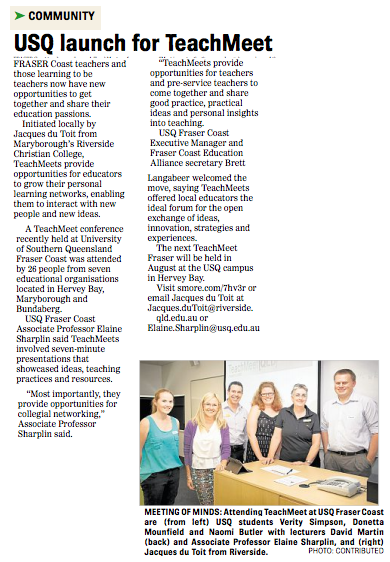
During 2015 I managed to organise 4 Teachmeets in the region, including two successful ones at the University of Southern Queensland Hervey Bay Campus with more than 20 educators attending. I absolutely love Teachmeets and what they stand for, the. The sharing by teachers is always inspirational, helpful and fascinating. 

I also presented at the first Teachmeet Sunshine Coast in March, and ran TeachMeet session at EduTech and presented at the same event. Teachmeets are definitely part of my future planning for 2016 and to see how we can have more in Queensland.


3 EduTech
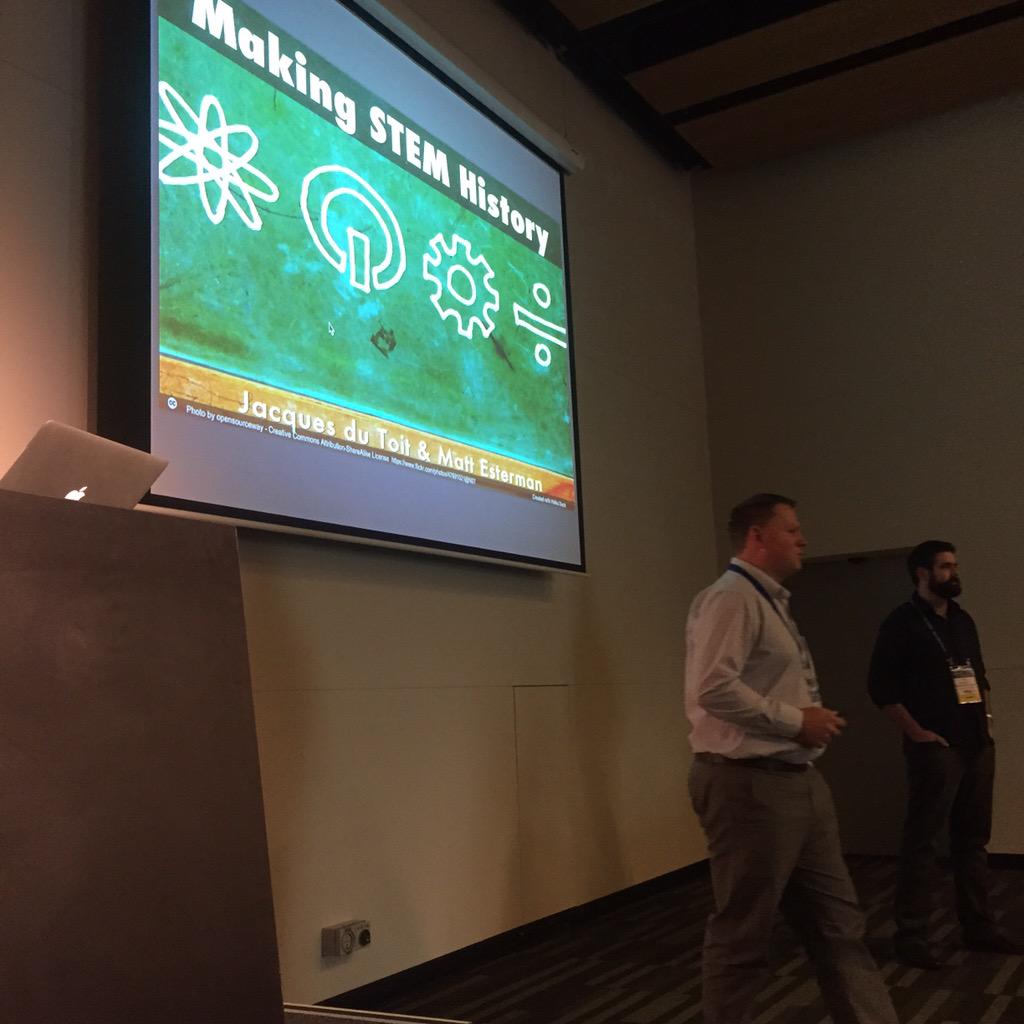
I was privileged to have the opportunity to be a speaker at EduTECH 2015 with Matt Esterman. Originally Simon McKenzie was also going to join us, but unfortunately could not, but he was still a great help with providing resources and support. It was great working with Matt and being part of the Conference. Matt is such a generous and passionate educator, and someone that I love connecting with. He is the one that introduced me to TeachMeets and I'm very happy to call him one of my closest edu-friends. EduTECH was great to attend because I managed to catch up with some edu friends from all around the country. The conversations outside the speakers is what I found the most beneficial and stimulating. 
Embedded image permalink
Picture by Helen Bremner (https://twitter.com/MrsHb)

4 Engage Summit
I was fortunate to be part of the Engagement Behaviour & Learning Summit at QUT in July. It was a great event organised by Linda Graham. It was the biggest audience I ever presented before, more than 300 people from all sectors of education. Check out some of the presentations online. Here is mine on using Social Media with my classes.


5 Masters
I started my Masters with CSU - Knowledge Networks & Digital Innovation this year and it has been extremely challenging juggling it with everything else. Two subjects down, and six to go. Along the way I managed to get a Distinction with the second subject - Design Thinking with Ewan McIntosh; and having a study partner in Jordan Grant to help and support.

6 Eric Sheninger
In May my school hosted Eric Sheninger for a workshop after I had made contact with him to set it up. It was great having him here and spending time with an educator that loves sharing his knowledge. The workshop was excellent, and just having him over for a relaxed barbecue was another opportunity to connect and chat. He also presented at the TeachMeet sessions at EduTech, and delivered a great Keynote. I look forward to meeting up again in the future and following along all the great work he is doing.
Me, Eric & Stuart Taylor


7 #28daysofwriting
Tom Barrett challenged people online to join him in doing #28daysofwriting to kickstart some creative and reflective writing of glogs. It was quite a challenge, but I'm so happy that I managed to complete it and write a blog each day. No idea how some people maintain regular blog posts, as I struggle to find the time or inspiration, but this was a good learning month with writing. Might need to challenge myself again to help this blog get a roll on.

8 Other Highlights
So much goes on in a school year, and there is so much to be grateful for. My students performed brilliantly and seeing them grow is what makes all this hard work worthwhile every year. I've had the chance to present at another school to share my knowledge of various tech tools, and helped teachers at my school become more proficient with Google tools. I helped a number of teachers write the Google Educator Level 1 exams and more to follow in 2016.There was the first ever Queensland EDCAMP, which was great to be part of and present at. The #TweetingAztecs project just keeps on going, and I have talked about it on many occasions; now I look at what else I can do. Doing a book review on TER Podcast, and being on one of the EduTECH episodes was another highlight. 

Lastly; seeing my wife get to half-way point of her School Counselor Education Masters and watching our 4 year old little girl develop, are the closest highlights to my heart. Spending time with my girls is my favourite part of every year.

I'm sure I missed a few points; but I know that everything that takes places, the good and bad, makes me into the educator that I'm becoming.

In 2016 I'm looking forward to being involved with the 3rd International Heutagogy Conference in Brisbane in May, presenting at the CSA Queensland Conference in July, continuing with my Masters Year 2, organising TeachMeets, daughter starting Prep at the school we both work at and anything else that happens along the journey.


Wednesday, 23 December 2015

Refocus

Where do I start?

At some point in the last few months, I have struggled to maintain my drive/motivation. There are many reasons behind this and I cannot go into great detail about much, but I'm slowly figuring out more through self-reflection. All teachers probably go through these times and it is important to try and re-establish some focus/goals. I absolutely love teaching, I love my students and seeing them develop and grow over their time with me. I love interacting with my PLN (even though I have been quite absent in recent times) as they inspire, challenge and help me grow. I love my family and the support I get from them. I'm eternally grateful for opportunities that have come along over the past 2 years.

I think my frustration and disappointment is stemming from seeing what great leadership could look like, how innovative practices can transform learning, how forward-thinking schools are led by leaders that lead and not just managed, seeing inspirational teachers and dedicated professionals inspire thanks to my PLN. Maybe this is just wishful thinking or an unattainable dream, but I hope it is not.

I want to be able to work where:
  • teachers opinions and contributions are valued, 
  • they have input in decisions that affect themselves and their students, 
  • they are part of the solution and help generate it through informed discussions, 
  • remunerated and treated fairly, 
  • respected and allowed to pursue new ideas to benefit their students.
Many of these points reflect what students are also looking for, and I'm trying my very best to give it to them, even when the systems restrict/hinder me from doing it.

Students want to be at a school where:
  • students opinions and contributions are valued
  • students have a say in the decisions that affect their learning
  • Students help solve problems/issues, rather than being the problem
  • they are respected
  • they are allowed to pursue their passions
Maybe I'm just rambling, but as I try and figure out where I head to next I need to put it down in words. I think the three parts that have kept me going, and kept me somewhat focused are: my wife and daughter, my students and some key members of my PLN. They are my sources of inspiration, the people that challenge me and help me become a better teacher.

I'm looking forward to the challenges and adventures that await in 2016 and beyond...


Monday, 7 September 2015

Literature critique for Masters

Here is what I have been working on over the past 10 days. My latest assessment piece as part of Master of Education - Knowledge Networks and Digital Innovation degree.


Wednesday, 2 September 2015

What am I up to?

This blog has been exceptionally quiet the past few months. 
I have been very busy with my senior students as they near the end of their school careers, presenting at events, running TeachMeets, a GEG Study group and my next unit with Masters program (Education - Knoweldge Networks & Digital innovation). I hope to get back into this blog site and update it with some of my reflections from the events from the past few months when Semester 2 finishes in mid-October. Until then, you can follow along on my Masters Blog site: http://thinkspace.csu.edu.au/riverflows/ or connect with me on Twitter @jdtriver

Friday, 29 May 2015

My Every Classroom Matters episode with CoolCatTeacher

One of my all time highlights of teaching happened a little while ago. At the end of last year I had a very successful activity that I blogged about - The #TweetingAztecs Project. This caught the attention of Vicki Davis (@coolcatteacher), one the educators I most admire and have followed online since joining Twitter in 2012. She wanted to interview me for her BAM Radio Podcast - Every Classroom Matters. I could not believe it, and was so excited for the opportunity. Interview was done in January and published online this month (on my birthday, coincidence?). It was such a privilige and fantastic experience. Have a listen and let me know what you think.

So, here it is:

This whole project and interview would not have been possible without the power of my PLN, TeachMeets, Simon McKenzie, my students, Vicki Davis, Lisa Durff and BAM Radio. Thank you all for helping me grow as a teacher and allowing me to share my passion.

Looking forward to more Australian educators feauturing on her show. 

Wednesday, 27 May 2015

Scholarly Book Review of Digital Leadership – Changing Paradigms for Changing Times by Eric Sheninger

Concepts and Practices in a Digital Age, Charles Sturt University, Scholarly Book Review Assessment, originally published on my CSU Thinkspace Blog

Review of Digital Leadership - Changing Paradigms for Changing Times by Eric Sheninger

Integration of digital technology into education has come to the forefront this century and it has become clear that educators of all levels need to adapt to serve learners in this new digital age. Change is required and Eric Sheninger explores in Digital Leadership - Changing Paradigms for Changing Times how educators can successfully and practically use technology to transform school cultures and create sustainable change. In Digital Leadership he shares personal experience, insights and examples of how educators have harnessed the power of technology to transform schools, and he establishes a framework to guide educators in becoming digital leaders. This review will focus on Digital Leadership’s role in providing a compelling argument and methods to initiate sustainable change, simultaneously acknowledging trends in information and knowledge environments that are created by social and technological changes in the digital age.

Eric Sheninger is a Senior Fellow and Thought Leader on Digital Leadership with the International Center for Leadership in Education. At time of publication of this book he was Principal of New Milford High School, New Jersey, where he had extensive experience in developing and implementing innovative practices with tremendous success. The practical examples lends to the authenticity and strength of the book. The book is aimed at school leaders, however the framework can be applied to classroom teachers too. It is broken up into two distinctive parts; the first part focuses on why a change is required, whilst in the second part he shares his ‘Seven Pillars of Digital Leadership’ in separate chapters. They are: communication, public relations, branding, professional growth and development, increasing student engagement and enhancing learning, rethinking learning environments and spaces, and discovering opportunity. These pillars are aligned to the 2009 International Society of Technology in Education’s (ISTE) National Educational Standard for Administrators and provide the framework for technological changes in the digital age.

Sheninger believes that school leaders need to acknowledge that modern learners are ‘wired’ differently, and their learning styles are in conflict with traditional teaching methods (2014, p. 15). There has been a societal shift in technology use, with social media, mobile devices and online communication driving a new knowledge ecosystem (O’Connell, 2015). This is supported by research from the PEW Research Center's Internet & American Life Project that finds, “92% of teens report going online daily — including 24% who say they go online almost constantly” and that the internet is a central and indispensable part in the lives of American teens and young adults (Lenhart, 2015). He utilises research from Childwise, Bloomberg, Strategy Analytics, mobiThinking, MacArthur Foundation, and others to explain the changing dynamics in accessing technology. 

A new culture of learning is developing, where information is networked and where participation is reshaping the way individuals learn (Thomas & Brown, 2011). Technology is driving this change, and this is why Sheninger believes it is so important to create learning experiences that are flexible, adaptable and that creates new skills in students for the twenty-first century. The Digital Media and Learning Hub supports this with their model of connected learning; which contends that connected learning involves an equal, social and participatory culture (Connectedlearning.tv, 2015). Sheninger explains that understanding how learners in the twenty-first century use technology is key to developing a school culture that will best meet the needs of students. Patricia Collarbone (2009), in Creating Tomorrow, supports the view that managing and leading the modernisation is required through an effective process for substantial, beneficial and sustainable change. Sheninger’s message here is about laying a foundation for students to become critical consumers of content, develop digital citizenship, and promote the ability to create, analyse and interpret media (2014, p. 35). Professor Yong Zhao (2012) also acknowledges in his book, World Class Learners, similar skills for students, the skills are effective communication, curiosity, and critical thinking.

Eric Sheninger reviews how the education landscape has changed, and the importance of school leaders taking charge in leading change management; highlighted with these quotes, “leaders must be the pillars of their respective institutions and focus on solutions rather than problems” (2014, p. 31) and “it is our duty to be agents of change” (2014, p. 36). Using examples from Seth Godin, Daniel Pink, Ian Jukes, Pam Moran, and Michael Fullard he highlights some of the reasons for change and why embracing digital leadership is key. Leaders need to join online conversations and take responsibility for the actions and education of future leaders, the students (Ahlquist, 2014). Sheninger blends into Chapter 4 the work of Michael Fullan (2008), a change expert, and discusses Fullan’s ‘Six Secrets of Change’ and how they are applied to Digital Leadership principles. Alongside this he deals effortlessly with obstacles that many schools face, and ways that they could be overcome with various strategies. Obstacles such as Wi-Fi, networks, budget cuts, government regulations and others are great concerns for many, and is an area that could be explored further. Each school situation is different, and Sheninger (2014) does make a point that “Each school is an autonomous body with distinct dynamics that make it unique. It's the small changes over time that will eventually leave a lasting impact.” (p. 70). The constant message is that it is a shift in mindset that is required for schools. Scott Klososky points out that education leaders today are becoming transitional leaders, “who are responsible for managing the transition to teaching and learning in a different way, preparing very different students to go into a very different world” (O'Brien, 2015).  As part of the transformation process, Sheninger highlights the importance of students having their voices heard in transforming school cultures, and this is an area of strength for the book.

In leading into the Seven Pillars, he shares some of the key areas of change at his school, New Milford, and his own personal journey. Points raised centre on how connectedness acted as a catalyst for change, importance of sharing a vision, supporting and empowering staff, establishing the value in changes and allowing students to be part of the process.. The driving question according to Sheninger is how we should use the technology that is available to us to improve what we do, instead of why we should use it to improve what we do (Sheninger, 2014). Chapters 5-11 explore this through explanations, how to accomplish it and showcases examples of educators that have paved the way. Social Media tools play an important role in almost every single pillar, along with the idea of ‘Connectedness’ being the conduit for supporting each of the pillars.

Communication, Public Relations and Branding are the first three pillars and they can be considered to be interdependent upon one another. Sheninger (2014, p. 86) says, “Educators must be experts in effective communication techniques, especially when it comes to parents and other key stakeholders”. Communication at the same time needs to be a two-way form, not a static one-way transmission, and social media allows this to take place. He uses examples from how to use Facebook and Twitter to communicate, plus discussions of Joe Mazza’s ‘eFace’ concept where technology is used to support Family and Community Engagement initiatives. Ribble and Miller (2013) also agree that technology and social networks provide a tremendous avenue for communication and building relationships. This is also noted by Bouffard (2015) that communication is at the heart of family–school relationships.

Communication is seen in both the next two pillars, Public Relations and Branding. Using the story of Van Meter Community School District under the leadership of John Carver, he explains how they used social media tools to establish a global footprint and craft their own message. This showcases the powerful message that, “If we do not tell our story, someone else will.” (Sheninger, 2014, p. 99). Digital Leadership allows schools to create a solid foundation for positive public relations using social media that complements communication efforts (Sheninger, 2014, p. 99). Branding allows educators to leverage social media and other digital tools to establish their professional brands in education. This is done through building connections, sharing, trust, and relationships with students, parents, teachers and stakeholders. These three boil down to establishing a schools message, communicating it and building a positive identity for the school. Sheninger mentions that communication is the most important thing he does every day (2014, p.89). 

In the Pillar for Professional Growth and Development, Sheninger discusses the power of creating a Personal Learning Network (PLN) and how to do this. He uses research from Alec Couros to showcase how an online PLN is crucial for modern educators. One of the key reasons why online PLN’s are so powerful for learning is that “Knowledge is shared, and not just taken” (2014, p. 119). Connectedness is becoming the standard for teaching professionals to grow, and  “Digital leadership require connectedness as an essential component to cultivate innovative practices and lead sustainable change” (Sheninger, 2014, p. 122). The learning model of ‘Connectivism’ acknowledges the shifts in society where learning is no longer an internal, individualistic activity, but rather deriving competence from forming connections (Siemens, 2004). Educators can now learn anytime, anywhere, and with anyone through leveraging the power of social media networks.

Increasing Student Engagement and Enhancing Learning Pillar ties together how leaders can support learners in developing knowledge, skills, and confidence to be successful in the twenty-first century. The key concept that Sheninger (2014, p.134) shares is that this new learning requires a constructivist, heutagogical approach to teaching and learning. Jackie Gerstein (2013) also explains that teachers, learners, networks, connections, media, resources and tools are creating a unique entity that has the potential to meet individual needs. Students want their learning to be authentic and meaningful. Students need to be at the centre of decision-making, and the strength in this book is how Sheninger constantly refers to utilising students’ voice to support the change. Students become educated on digital citizenship, responsibility and creating positive digital footprints; something that many schools are failing at. Students have a wide-ranging set of technology skills, this is changing teaching methods, as well as when and how students learn and many schools are integrating digital citizenship training as part of their school improvement efforts (Ribble & Miller, 2013). He often refers to pedagogy first and tools second in creating sustainable change, making it clear that devices and technology always come second.


Learning environments and spaces pillar links in well with creating learning areas that are flexible, foster creativity and facilitate learning. He demonstrates this with the Gahana Jefferson District example of how they re-imagined spaces and how they could be utilised. The issue of school redesign he believes should be part of any educational reform process. Discovering opportunity rounds up the Seven Pillars, and once again he links the pillars together and summarises how they are interdependent on one another. Through working on the first six pillars it will allow leaders to find innovative solutions, share their stories and model digital leadership. This will then result in countless opportunities for schools, educators and students to open up.

Connect, collaborate, share, create and communicate are cornerstones for the 21st century educators and through Digital Leadership - Changing Paradigms for Changing Times, Sheninger provides an informative and practical guide on how to initiate the change. He addresses the paradigm shift that is taking place due to connectedness, ubiquitous nature of information and accelerated changes in technology. Through his own story, that of other innovative educators, and supported with various external sources, he showcases how they have responded to the change. He acknowledges that at the heart of digital leadership, the human interactions will always remain the key component in changing education (Sheninger, 2014, p. 191). For school leaders there is no longer a debate on whether or not to be a digital leader, Eric Sheninger successfully provides a clear framework on why and how to initiate the change.


References


Ahlquist, J. (2014). Trending Now: Digital Leadership Education Using Social Media and the Social Change Model. J Ldrship Studies, 8(2), 57-60. doi:10.1002/jls.21332
Bouffard, S. (2015). Tapping Into Technology: The Role of the Internet in Family–School Communication / Browse Our Publications / Publications & Resources / HFRP - Harvard Family Research Project. Hfrp.org. Retrieved 17 April 2015, from http://www.hfrp.org/publications-resources/browse-our-publications/tapping-into-technology-the-role-of-the-internet-in-family-school-communication
Collarbone, P. (2009). Creating tomorrow (p. 11). London: Network Continuum.
Connectedlearning.tv,. (2015). Connected Learning Infographic | Connected Learning. Retrieved 14 April 2015, from http://connectedlearning.tv/infographic
Fullan, M. (2001). Leading in a culture of change. San Francisco: Jossey-Bass.
Gerstein, J. (2013). Schools are doing Education 1.0; talking about doing Education 2.0; when they should be planning Education 3.0. User Generated Education. Retrieved 16 April 2015, from https://usergeneratededucation.wordpress.com/2013/03/22/schools-are-doing-education-1-0-talking-about-doing-education-2-0-when-they-should-be-planning-education-3-0/
Lenhart, A. (2015). Teens, Social Media & Technology Overview 2015. Pew Research Center's Internet & American Life Project. Retrieved 13 April 2015, from http://www.pewinternet.org/2015/04/09/teens-social-media-technology-2015/
O'Brien, A. (2015). School Leaders: Guiding Teachers into the Digital Age. Edutopia. Retrieved 15 April 2015, from http://www.edutopia.org/blog/school-leaders-guiding-teachers-digital-age-anne-obrien
O'Connell, J. (2015). 1.3 Trends in Technology Environments. Lecture, Retrieved March 20, 2015, from Charles Sturt University website: https://interact2.csu.edu.au/bbcswebdav/pid-249312-dt-content-rid-635255_1/courses/S-INF530_201530_W_D/module1/1_3_Trends_tech.html.
Ribble, M., & Miller, T. (2013). Educational Leadership in an Online World: Connecting Students to Technology Responsibly, Safely, and Ethically. Journal Of Asynchronous Learning Networks,17(1), 137-145. Retrieved from http://eric.ed.gov/?id=EJ1011379
Sheninger, E. (2014). Digital leadership. Thousand Oaks, California: Corwin Press.
Siemens, G. (2004). elearnspace. Connectivism: A Learning Theory for the Digital Age.Elearnspace.org. Retrieved 17 April 2015, from http://www.elearnspace.org/Articles/connectivism.htm
Thomas, D., & Brown, J. (2011). A new culture of learning. [Lexington, Ky.]: [CreateSpace?].
Zhao, Y. (2012). World class learners (p. 8). Thousand Oaks, Calif.: Corwin Press, a Joint Publication with the National Association of Elementary School Principals.